
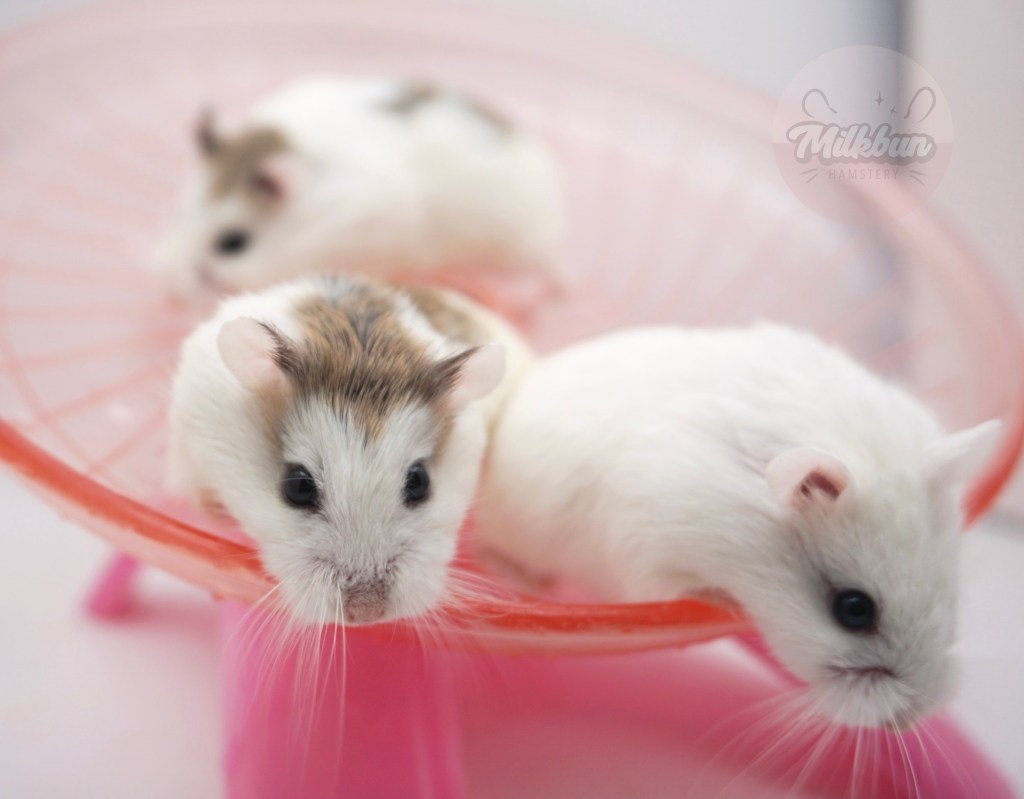
🍡 Question: “What differences in enclosure setup are there between housing a lone robo and housing a group/pair?”
🎀 Milkbun Hamstery: I would say that the main difference would be enclosure size – but not in the way most would probably expect. We as loving humans want nothing more than to spoil our critters and keep them in conditions that allow them to be as happy and healthy as possible, and what we picture as a part of that ideal is an enclosure which as much space as possible. Unfortunately though, what robos have seemed to “tell us” over the years is a rather different preference. A proper enclosure for a robo must be clean, cozy, enriching, and feel safe to them. If those conditions are not met to them, robos with naturally stable temperaments can often become suddenly skittish, fearful, and in the case of cohabbing – become territorial towards each other. I do want to stress that this is not true for ALL robos (truly nothing is black and white when there are so many factors that can come into play, such as genetic temperament or negative experiences), but there are so, so many times where an owner will be confused about why their robo is suddenly afraid of them, or their robos are suddenly fighting, and if you ask whether they had recently upgraded their cage to the extreme “proper minimum” according to other owners online, the answer is almost always yes.
With this important caveat, I am often asked how high difficulty it is to keep my robos in colonies. My colonies almost never fight, so not really for me, but I also think that you need to have the right mindset to have a successful colony, and that it takes time and experience to be able to read robo body language fluently. This is a topic that I’m very passionate about, so I always welcome questions about it, especially because there is such little information out there on this that everything I tell people is completely based on my firsthand experience, not things I’ve heard elsewhere. But yes, the most important thing to maintaining a robo is NOT changing the environment too much space wise. If your current set up is working and they’re all getting along well, do not try to give them more space unless you are willing to do it very slowly over a period of time so that they don’t really notice (and subsequently freak out).
Now, I hesitate to say completely that “solo robos can be in as big of a cage you want, while you can’t do that with a colony”, because while it’s technically true, there is also a pretty large con to giving a solo robo too large of a cage as well. Now, I have had pet owners (particularly my retired stud boys who were already very used to me taking them out and playing with them every day) have great success in upgrading them to rather large enclosures and having them maintain the same tame personality – which I absolutely love. But in most cases, if you take your new baby robo home and put them in the huge space, it’s highly likely that they’ll find it all very overwhelming and not be very receptive to bonding/handling. This behavior looks like quickly bolting underground or into a hide whenever there’s a noise or you approach the cage, hiding all day, freaking out when you try to pick them up, etc. I pride my breeding program in years of selecting specifically for a calm, friendly temperament, but even these tamer temperaments can be overridden by an instinct for fear in the wrong conditions. If you have a pet store robo with a very poor temperament that will never be able to be tamed or you don’t mind potentially not being able to handle your solo robo and prefer to have an observation pet, then by all means, that is completely up to you! But if your goal is to have a tame pet you can handle daily, you should be prepared to meet those needs.
I also think I should address that personally, I wish robos (solo and colony) THRIVED in large cages. Way before I became a hamster breeder, I was a devoted pet owner. I love the look of the DIY Ikea cages (I used to have a custom Linmon for my Syrian, Milky) very large Bucastates, and all of the sheer decorating possibilities with all that space. (If you haven’t noticed yet, I am quite a fan of pink decor and cutesy ceramic pieces!) I was in the Hamster Hideout forums from the beginning and on Reddit as a pet owner for many years, and I was a VERY loud advocate for the ethical minimum cage sizes and being anti-cohousing. Now, it’s important to note that at the time, the information I was giving other pet owners was mostly based on what everyone else in the hamster community was telling me, rather than personal experience and anecdotal evidence. When I first started breeding robos, I was also of a fairly similar mindset (though more willing to be open minded), but I learned very quickly that the robos themselves were singing a very different tune than what I had read online about cohousing.
Cage size is undoubtedly a topic most hamster owners get very passionate about, but I’ll just point out that I would have no reason to be so adamant about the importance of a cage size that the robos themselves are the most comfortable with if I didn’t care so much about them. But I do. I want my adopters to be able to enjoy my babies as much as I do, and a part of that is ensuring they are in the proper conditions to be friendly, relaxed, and comfortable being with others.
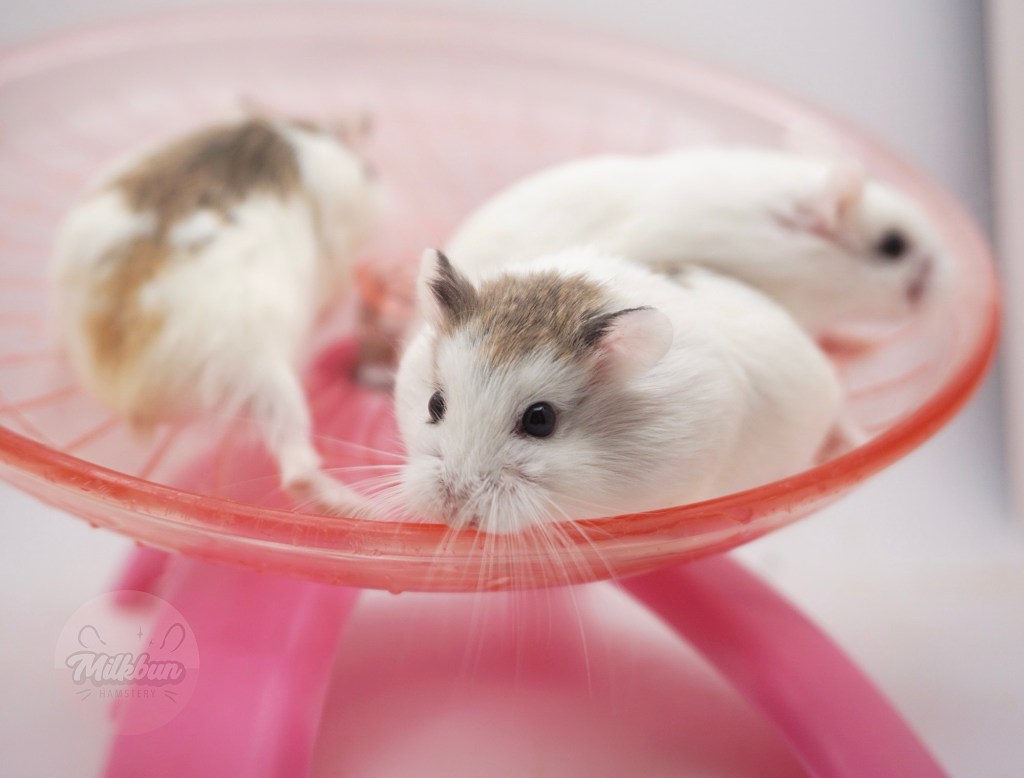
Another difference is the number of hides and wheels in a cage. If you have just one robo, there’s definitely not really such a thing as having too many accessories. But a piece of advice you’ll sometimes hear on the hamster groups regarding pairs or colony dwarfs is the “two of everything” rule. This supposedly applies to both Russian type dwarfs and Roborovskis, where they say in order to have a successful pair of dwarfs, you need to make sure they have two of everything – two wheels, two or more hides, two food bowls, two water bottles, etc. Well… while this sounds pretty good on paper, this usually tends to have the opposite effect than what you want. In pairs or colonies, the kind of environment you want to encourage is a place of sharing and overlap, not a space where hamsters can decide to “claim” a specific area of the cafe or decide to be possessive over specific items. Now, if you look at videos of my colonies, I have multiple hides and many different accessories for them. This is because when I’m establishing a new colony or introducing new hamsters to live together, I start off by only giving them one hide and one wheel. That way they just get used to being in very close proximity to each other and sharing everything. Then over time I will tend to add things.
Those two things are the main differences I can think of for enclosure setup of a lone robo vs multiple robos.


Leave a Reply