
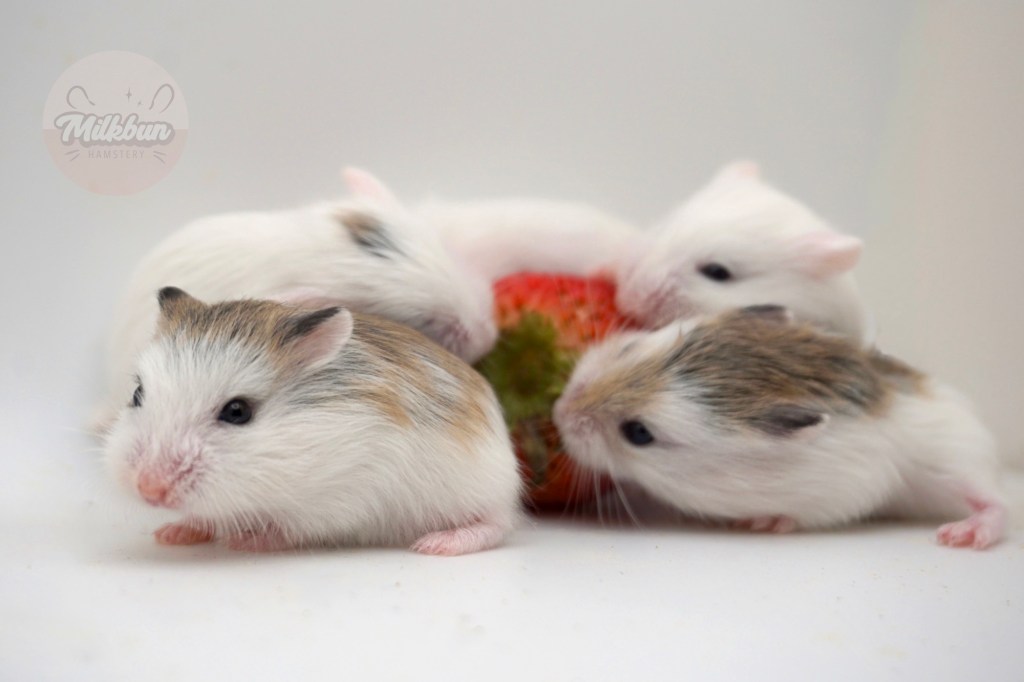
Some months ago, I posted a Q&A, and received some wonderful questions, especially about cohabbing robos. For as long as I’ve been involved with hamsters, cohabbing robos is an oddly elusive topic, with few reputable sources to be found in English. Since this is a department I have pretty significant experience with, I thought I would sit down and answer some of these.
Thank you Jenei Dori for these interesting questions!
🍡 Q: “What are the benefits of cohabbing?”
🎀 A: Roborovski hamsters have not been kept and bred in captivity for very long, especially compared with fancy mice or even Syrian hamsters. Because of this, I feel strongly that we should keep an open mind and evaluate their social preferences according to the individual animals and circumstances rather than treating every situation as identical.
The period during which robos have lived under human care is incredibly short compared with the long history of the species, so their natural way of life is still worth considering. At the same time, domesticated animals can change significantly through selective breeding. For example, repeatedly pairing friendly, nonconfrontational robos is likely to produce more offspring with similarly social and tolerant temperaments.
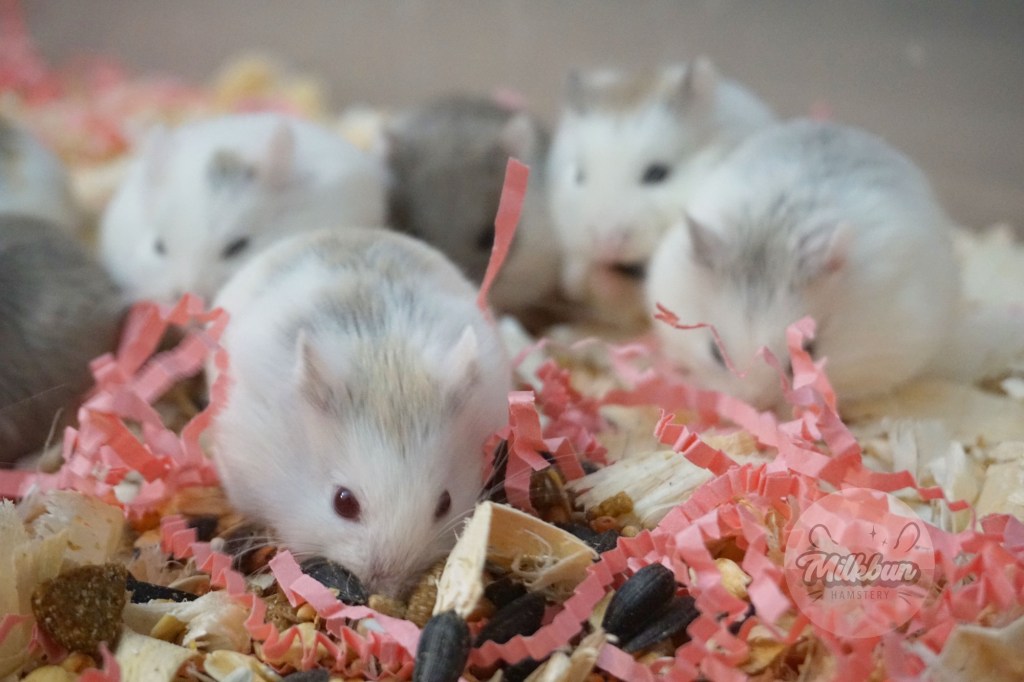
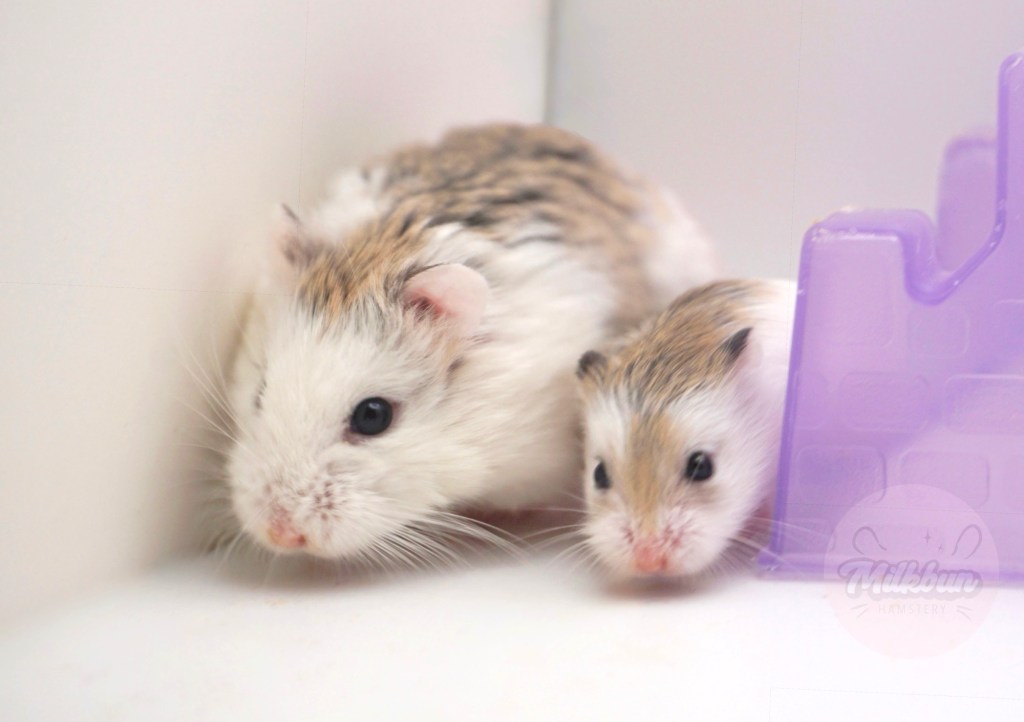
In the wild, Phodopus roborovskii hamsters tend to live in colonies consisting of a breeding pair and their subsequent offspring. In captivity, robos living in compatible groups spend a great deal of time grooming one another and actively choose to sleep together in shared dens and warm piles. Even when several sleeping and hiding places are available, they will often choose an occupied hide over an empty one and curl up directly beside (or on top of) their buddy.
As prey animals, robos are naturally alert to danger. It seems that they may find reassurance in seeing that the animals around them are unharmed and relaxed: if everyone else appears safe, they can relax too. I notice a significant difference between many of my newly solitary robos and those living in colonies. Mature males are often intolerant of other mature males in their territory, so they usually need to live alone. Once comfortable, some solo robos begin seeking human attention, although this also depends on how outgoing the individual hamster naturally is. Most of my solitary robos, however, when not being handled, tend to spend the majority of their time underground in their nests or on their wheels. Because I’m their only friend, they will come out at the sound of my voice though, and they can be more needy than colony robos.
My colonies are often more active throughout the enclosure. They spend more time running around, exploring, and comfortably remaining out in the open. Adult females in particular usually seem to enjoy one another’s company, so when they are compatible, I prefer to give them the opportunity to live socially. I don’t think that being in a colony “replaces” my attention for robos like it does for female mice, though. In my colonies, I have specific females that LOVE me and always want to be handled, and some females that aren’t that interested in me and are content to stay inside.
That said, I do not believe that solitary male or female robos are necessarily unhappy. Cohabbing is not essential for every individual, and an incompatible group can be far more stressful than living alone. The greatest benefits appear when the animals are genuinely compatible – companionship, mutual grooming, shared sleeping, social interaction, and possibly a greater sense of security than solo living.
I also find colonies fascinating to observe. Group living allows you to see each hamster’s individual personality, relationships, and natural social behaviors in action. Introductions can be difficult and must be handled carefully, but once a stable group has been established (and its environment remains consistent enough not to create unnecessary tension, as this is how you can cause a colony to fall apart) things are often very smooth from that point onward.
For example, it’s widely accepted that gerbils should have companionship, but it’s also commonly observed that a pair can be fine for a significant amount of time and then suddenly turn on each other overnight. That’s not really a normal thing for robos in my experience, I’ve never had that happen in my personal experience. Usually if that does happen, it means A) one of the females is pregnant and subsequently hormonal, or B) I recently upgraded the size of the cage to something larger and it’s causing them to feel territorial. But it’s quite rare.
🍡 “Q: When do I know if a cohab just won’t work out?”
🎀 A: In general, after a smooth introduction and being settled in, robos will genuinely be fine with each other. However in order for this to happen, the introduction process needs to be handled carefully and properly, so I will go over how I handle introductions in detail now.
Basically, it is a three step process. Step one is the “hand introduction”. Hand introduction is when you have a hamster in one hand, and the other hamster in your other hand. You bring your hands together to let them sniff each other and test their initial reaction. The reason why is this the first step is because usually, they are less confident in your hand because your hand is moving around and off the ground, so they are less likely to go ahead and attack if they are so inclined, and you can easily pull your hands away if the reaction isn’t good. Step two is the “bare container introduction”. This step is where you prepare a small (shoebox sized) container with no bedding or food to introduce them in. The container should be washed beforehand so it doesn’t smell like anyone else in particular. Step three is to introduce them to their new enclosure (with FRESH bedding). It’s better for this enclosure to be relatively small and cozy, and have no more than one hide and wheel, as it encourages them to get used to being in close proximity, share space, and for their scents to merge together. If you put them straightaway into a very large enclosure and seven different hides, they’ll mostly likely scatter throughout it at first, and then be surprised and defensive whenever they encounter these new strangers infrequently…
A huge, common mistake I often see for introduction is when someone will add a new robo to an existing robo’s home. If a stranger came into your own home with no explanation, wouldn’t you also be defensive and angry? That’s very different from meeting a potential new roommate at a café and then moving into your new shared apartment at the same time.
Now. I would say that there’s generally 3 different safe situations for introducing robos. The first one would be introducing an adult male to an adult female for breeding purposes. The second is introducing weaned babies to an adult female/adult female colony. The third one would be introducing an adult female to another adult female/adult female colony.
Introducing an adult male to an adult female is a pretty straightforward process. Usually, adult males are very curious about, open to, and sweet to females. They’re also persistent, because well, he wants to check when she’s coming into heat. I start off by holding the male in one hand, and the female in the other. I’ll hold the male’s nose close to the female’s rear to show him first that this hamster is female, so he’ll already start to be receptive. Then I’ll do the same to the female, let her sniff his rear to show her that he is a male. Then I’ll allow them to sniff each other’s faces. If they’re okay, then I’ll put them in a small, bare container. Usually what this looks like at first is the female will wander around, sniffing the environment. The male will follow the female around very enthusiastically, sniffing her groin. If a female is younger or more nervous, she might squeak at him or run away at first, while a confident, mature female will usually just ignore his sniffing. There might be a little bit of chasing, but usually it’s not very hard to introduce a male and a female.
Introducing weaned babies to an adult female/adult females is also pretty simple. Usually I will start weaning babies from their mother at about 4 weeks of age, though it’s not really a big hurry to do so. Male robo babies aren’t really like Syrians, who might breed their mother/sisters immediately at a young age. Male robo babies usually take a little longer to be interested in breeding, so I’m often comfortable keeping them with their mother or other adult females for a while yet. Adolescent robos are usually very open minded and easy going with meeting new robos. They’ll just be friendly and curious, which is because their hormones and stronger personality traits are not yet fully developed. Adult robos will also generally recognize young robos as a non-threat, so it’s typical for them to be friendly back. If I want to add adolescent robos to an existing adult female colony or give them a human-social “auntie” to live with so they learn that I’m a friend, I’ll usually skip the hand introduction and place the babies in the small, bare enclosure first. Then I’ll add the adult female, and see how she reacts to them. Usually, the adult female will recognize them as young robos and be totally fine with them. If it’s an adult female colony that will be combined with the youngsters, it’s important to put all of the babies in first (as the babies don’t usually get defensive), then add the adult females one at a time. Then once everyone’s okay and happy, add them to a cozy sized enclosure with FRESH bedding. Also make sure that all hides are washed, so it doesn’t smell like anyone in particular.
Introducing adult females or an adult female to an adult female colony is something I do very regularly, but I would say that it requires the most discretion and knowledge out of all of them. This is because mature females have their hormones, go through heat cycles, and have existing personalities. I’m often asked if females that have had babies before can live with other females. The answer is yes, my colonies are mostly made up of retired moms. However adult females will be hormonal/defensive towards other hamsters when they are pregnant or nursing babies (though oddly they don’t do that towards their adult offspring when pregnant), so I usually wait until my moms are weaned from their babies for a week or so before introducing her to an adult colony, because she might still feel a little lingering protectiveness. So I will go through my process of hand introduction -> bare container introduction -> fresh, cozy sized enclosure. Adult females do not have to related to be peaceful cagemates, but the younger they are, the easier it is.
Usually, if an introduction doesn’t go super well, I’ll troubleshoot a few different ways or try again later, but sometimes there are specific cases where it just won’t work out. For example, sometimes there’s a rare case of a female robo that just doesn’t share well with others, and would be best as a solo pet. That’s perfectly fine. Sometimes there’s an adult female robo that has lived alone as a solo pet her entire life, so she’s so far removed from remembering how to interact with others robos, so she won’t ever be receptive to cohabbing. That is also totally fine. Sometimes a robo’s natural temperament is just so nervous and skittish that she makes everyone else nervous, and none of them like her. That’s also happened before. It really depends.
So a quick note about colonies – Newly introducing a colony of mature adult females can require some finesse and experience with robo body language, so if you really want a colony for the first time but are nervous about it, I would recommend a specific way of going about it. Which would be, raising your own. A mother and her daughters are used to each other from birth and already bonded, so it is the easiest way to have a colony without the difficulty of introducing mature strangers to each other. I’ve had a pet owner ask to borrow one of my sweet stud boys (Cinna) in order to create a pet colony, and it worked out very well. It’s not something I usually do, but I’m open to discussing it if you’ve done your homework and genuinely want to try it.
There’s frankly zero detailed information out there about introducing robos or maintaining robo colonies, so this all things that I have learned and observed firsthand. If anyone has any specific questions or needs to help, please feel free to reach out anytime.
🍡 “Q: Should I feed different diets at different life stages?”
🎀 A: I don’t think I’ve ever addressed what I actually feed all of my hamsters so I think I will go over that first. Often whenever I am asked by adopters for food recommendations, I will suggest Higgins Sunburst mixed with Mazuri Rat & Mouse, as that is what I have used for years, and both of those components are readily available at Petco and Petsmart. However, I do make my own bulk feed mix of bird seed, dried mealworms, oats, cat food, dried vegetables, and chunks of biscuit. It’s really quite simple, and the robos never seem to go out of condition on it. Technically speaking, lab blocks (pellets) are specifically formulated by scientists to provide good nutrition for rodents on their own, so I don’t think it’s wrong or improper for other breeders to feed that alone (to each their own). But watching my robos pick and choose what they would like to eat from the pile and knowing which ones are their favorites brings me an unreasonable amount of joy and “SQUEEEE SO CUTE!!!”, so I love to give them a wide variety.
Onto the actual question instead of my soft heart – is it necessary to change diet based on life stage? Baby robos begin to wean off of their mother’s milk and instinctively venture out of the nest in search of food at around 12-14 days of age. At this point, their noses are extraordinarily curious. It’s quite hilarious to put down a piece of fragrant food (such as scrambled egg or boiled chicken) and watch the blind babies crawl out from their den in a wobbly, hungry, adorable herd. Robo babies can survive perfectly fine with supplementary fresh food provided to them (as their mother’s milk is still what they mainly need at this point, and they instinctively know to nibble on the seeds she already has hoarded in the nest around them). However, I always do provide extra fresh food, as it’s nothing but beneficial to their development, and it encourages them to come out. For the babies, I like to provide scrambled egg, plain pasta, unseasoned boiled chicken, lettuce (a fan favorite), live mealworm pupae (another fan favorite, very nutritious, and since the pupae stage can’t bite the babies), and small amounts of fruits. Hamster milk is comprised of about 70-80% water, so before they start learning to use the water bottle, babies get the hydration they need from Mom. But it also doesn’t hurt to provide them with more from fruits and veggies.
For adolescents and adults, there isn’t much extra planning I tend to do for their diets. I feel that comparatively to other rodent species, hamsters in general are quite hardy creatures in that department. As a robo ages however, elderly individuals often lose weight. To help with maintaining weight, I will often provide meat baby food and extra protein through live mealworms and pieces of chicken or egg.
Got more questions?


Leave a Reply