
Breeding is a very rewarding and interesting endeavor. While I recommend doing significant amounts of research and taking time to consider your goals, you will find that there is much to be learned through firsthand experience.
Introducing your breeding pair
When a Robo is meeting someone new in a neutral space, and doesn’t feel any need to be hostile, they will briefly meet face to face, with their faces slightly pointed upwards, like so:

When introducing a female to another female, or a female to a group of females, they will usually immediately resume zooming around in the neutral container after a moment. That’s a good, healthy sign.
When introducing a male and a female, right after this moment, the male will usually begin to chase the female around, and try to get her on her back to sniff her genitals, like so:

After a few seconds, they will resume zooming around.
One of the great things about Roborovskis is that, in your first meeting, you can often tell right away how well they’ll get along with each other. Unlike gerbils, which sometimes ‘declan’ or fall out after living peacefully for a long time (often due to exposure to a foreign scent), Robos generally don’t seem to have this issue.
For a breeding pair, I recommend choosing a very cozy sized enclosure with sufficient bedding for nesting and no wheel. Ceramic or plastic hides and cardboard tubes are good inclusions, but they will nest with ease without one as well. It is important to consider that with ceramic hides, there is risk for a mother choosing to burrow underneath it, which makes it difficult to retrieve the babies, and also creates the possibility of the babies being much harder for the mother to access.
In a maternity bin is too large, it can significantly impact the mortality of the litter. The mother can be too stressed out and forget the location of the babies, or neglect her young outright. The chances of a mother eating her babies is much greater on the first few days after their birth, and decrease significantly as they grow.
Studying the temperament of your hamsters and the quality of their type is crucial when selecting your breeding pairs.
Here is a video of Roborovski hamster mating behavior:
Gestation (pregnancy) in the Phodopus roborovskii is 20-22 days.
Should I keep the male in with the pregnant female?
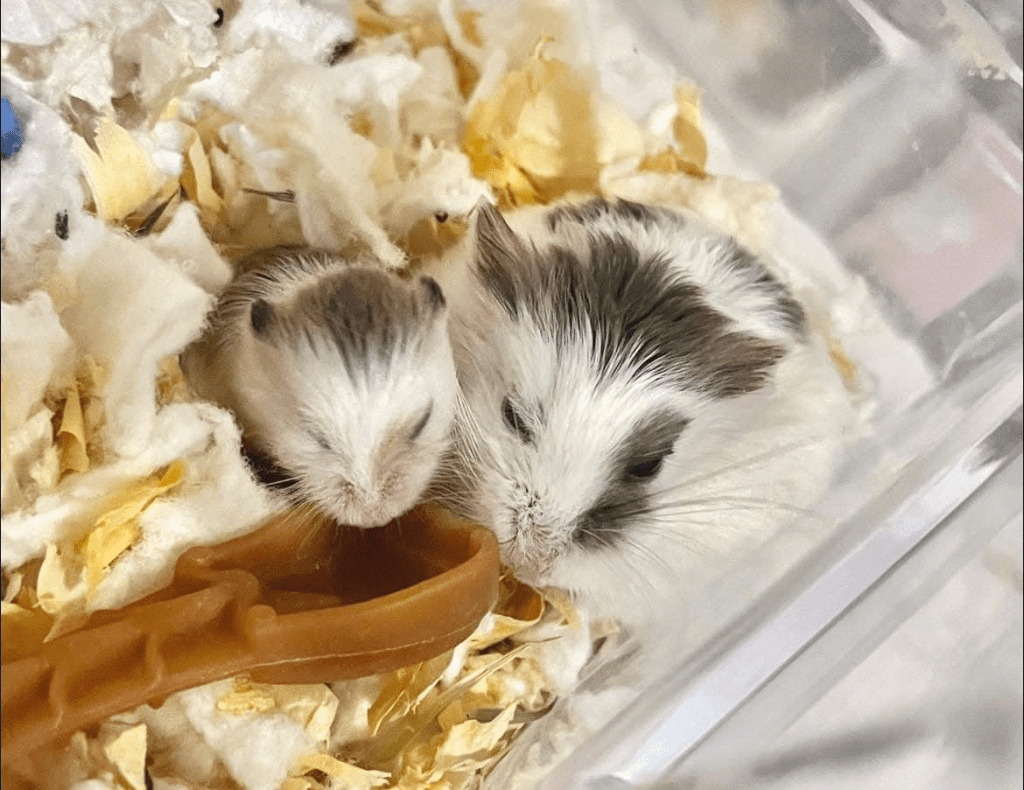
You can keep the father in if you wish, but it is also equally fine to separate. If they successfully have a litter, the mother will raise the litter in the nest, and she will have her mate to sleep elsewhere in the cage until the babies are old enough to open their eyes and walk around. The father instinctually does not attempt to intrude the nest, and she doesn’t defend it from him, generally they will behave normally as mates when she exits the nest.
When the babies start escaping the nest (12~ days old), the father will begin bringing food to the babies and start grooming them.
Scientifically, the mom will go back into heat the day she gives birth, so it’s a possibility she will mate again, but that is your risk to take.
The majority of my matings, I have removed the male, but in the 3 times that I have experimented with keeping the father in, a repeat breeding hasn’t happened. But it’s definitely possible.
As for the potential babies, sibling groups do fine together well into maturity (Robos prefer company), but you would typically have to be careful that the enclosure isn’t too massive, as that can cause them to feel the need to become territorial.
Newborn (0-5 days old)
Firstly, here is a link to a very detailed account with photos of the development of Roborovski pups by Oak Farm Hamstery.
While I have a library of photos of my adult and weaned Robos, I have yet to take more professional photos of the much younger babies.
From birth, Roborovski pups are very loud. Even if you can’t see them yet, you will certainly be able to hear the ‘plink, plink’ noise of their tiny squeaks as they nurse from their mother. You will seldom see the mother at this point (though the mothers are more active (even with newborns) if she has older pups that will help keep the babies warm while she’s away).
The babies are very small, hairless, and dark red. As they grow, the dark red skin turns into a pale pink. At about day 4, their future markings will be visible in their skin, where you can identify which babies will be pure white, agouti, pied, etc.
Growing in the Nest (6-11 days old)
Over the next five days, the babies will began to develop a fine layer of hair, with stronger squeaks. They still remain in the nest with their eyes closed.
Escaping the Nest (12 days old)
At around the 12 day mark, you will begin to see the babies begin to wander out of the nest for short periods of time in search of food. This is the point where the babies will began to experiment with new foods and be very sensitive to smell. You can introduce new things for them, such as lettuce, oats, and baby food, and they will detect it right away, being very eager to find it. This is also where you will see that some of their eyes are beginning to open.
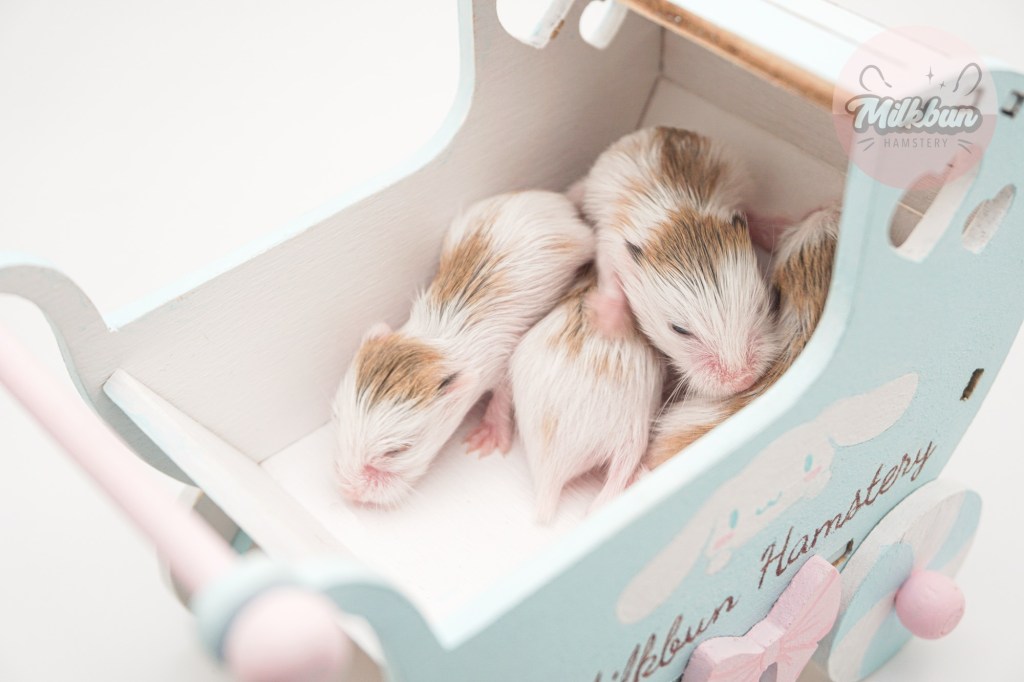
Active pups! (15 days old)
As the litter grows…
After the babies continue to grow up, it is very humorous to see their interactions with their mother and each other. The young pups will often play fight, cuddle, and tussle.
Adolescence
There is a lot of worry surrounding what to do as the pups get older, but it’s not very necessary. Some hamster species are much more vigorous of breeding (such as sons breeding with their mother, siblings, etc), but Robos seem to require certain conditions to decide to breed.
For example, the parents will likely mate again after the birth of the first litter (though not always), and the littermates don’t usually breed with one another after sexual maturity within their family colony. The older litter will help their mother care for and keep the younger litters warm.
It’s perfectly fine to keep the youngsters for a long time in with their mother, and it is likely their preference, as they are comfortable with their family.
However, depending on your breeding goals, it will likely be necessary to use the resulting offspring for your future breedings.
If you have multiple litters from different pairs, it is very simple to combine the weaned (not needing their mother’s milk any longer) litters.
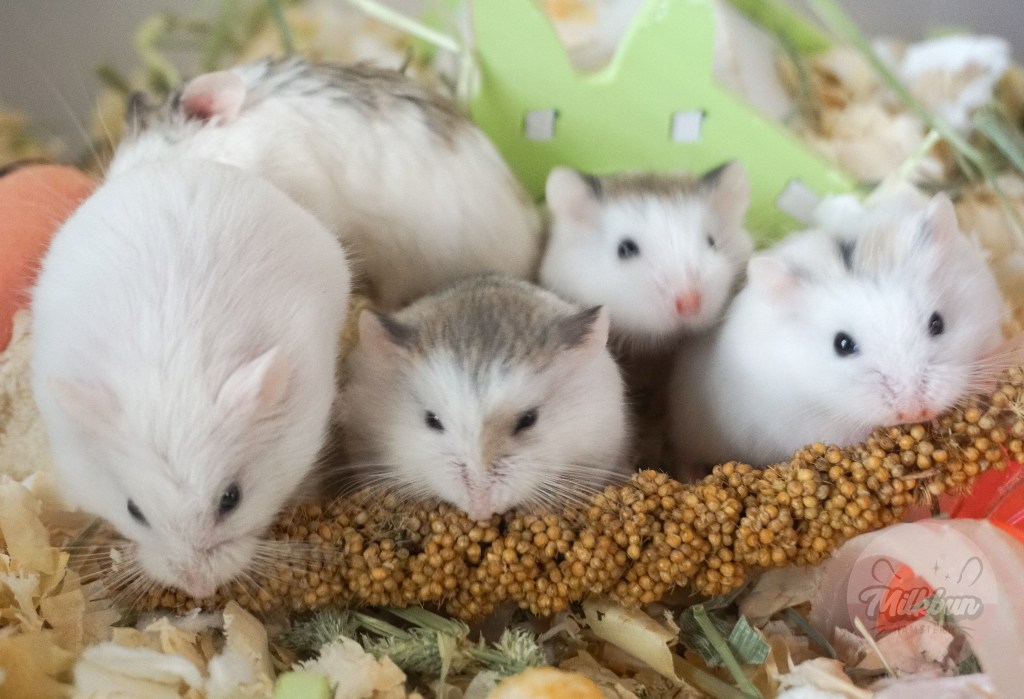
The pups are very laid back, and you won’t really find the same behaviors that adults being introduced will exhibit. The pups will treat each other all in the same way, like new littermates.

 Milkbun Hamstery | Roborovski Dwarf Hamsters